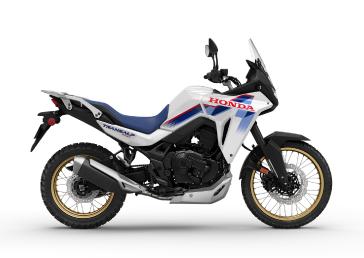
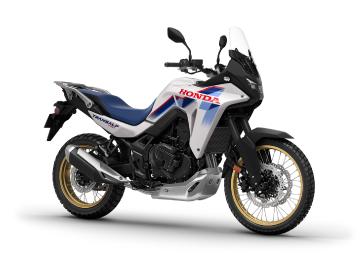
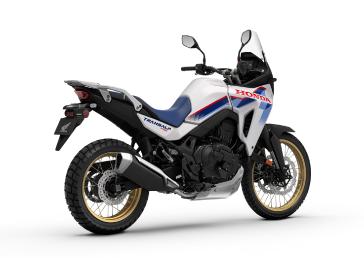
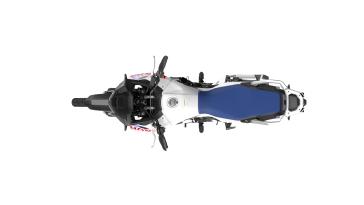
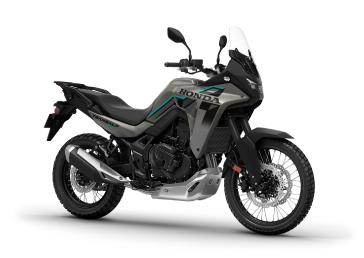
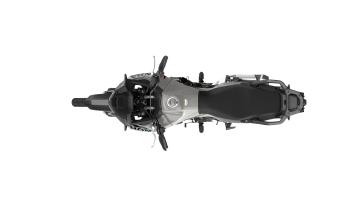
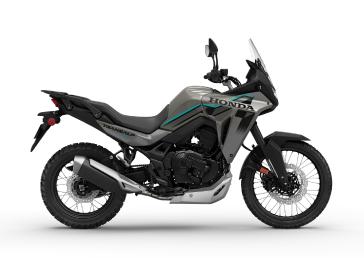
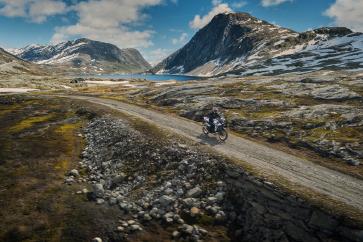
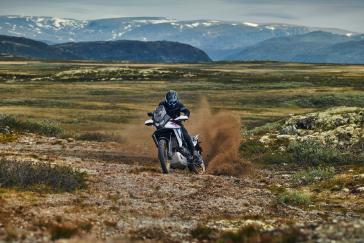
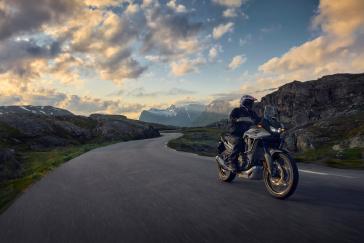
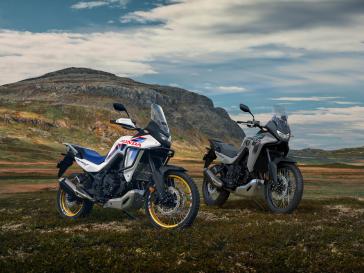
Honda's Transalp is built for adventure, combining versatility, capability and long-distance comfort in a well-balanced package. For 2026, it receives an important upgrade in the form of Honda E-Clutch which, in combination with throttle-by-wire technology (TBW), provides smooth shifting and excellent low-speed control on pavement and dirt. A new aluminum skid plate provides added protection and a boost of stylish ruggedness, while new, fully adjustable front and rear suspension allows riders to tailor performance for varying terrain. With comfortable ergonomics and ample fuel capacity, the Transalp E-Clutch is a versatile companion for adventure enthusiasts seeking both performance and practicality.
HISTORY
Although only offered in the U.S. in 1989 and '90, the original Transalp—powered by a 583cc V-Twin engine—was something of a legend in Europe, where it was introduced in 1986. Back then, it was a comfortable, do-it-all crossover that could cope with rougher ground thanks to long-travel suspension and a light off-road dynamic. It came with 18-inch rear and 21-inch front spoke wheels for good performance in the dirt, but it was the first Honda adventure bike to be equipped with a fairing for improved comfort on the road. By 2000, the engine had grown to 647cc in Europe, and the last version in 2008 featured a fuel-injected 680cc powerplant.
The adventure segment has expanded massively since the Transalp first appeared. Honda has the superb, small-displacement NX500, as well as the flagship Africa Twin. Introduced to the U.S. market for the 2024 model year, the current-generation Transalp slots into the mid-capacity sector of Honda's adventure lineup, giving customers a balanced option that blends long-distance touring comfort with agile, off-road-ready performance. For 2026, the Transalp benefits from the addition of Honda E-Clutch technology.
NEW FOR 2026
- Honda E-Clutch technology is now standard.
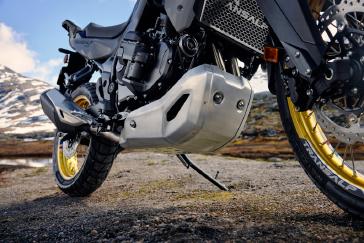
- New aluminum skid plate offers rugged protection and a stylish look.
- Fully adjustable front and rear suspension enhances versatility across a wide range of riding conditions.
DESIGN / STYLING
In imagining the perfect lines for the Transalp's bodywork, the aim of the Rome, Italy-based R&D designers was to strike a balance between aerodynamic performance and wind protection at speed, while maintaining a sense of lightness and freedom at low speeds. The concept tagline used throughout was "Friendly Toughness."
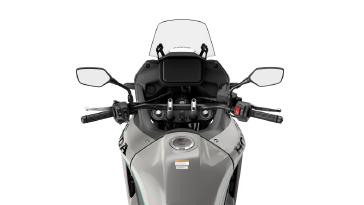
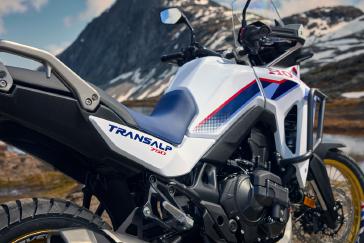
The Transalp's design projects an unmistakable feeling of adventure touring in a package that works superbly on the road. The long-legged stance makes a strong statement of adventurous intent, while the fairing and screen work together to deliver wind protection without bulk. The front end takes some styling cues from the flagship Africa Twin and is built around a headlight unit that comprises dual LED high/low-unified projector lenses.
The overall look is sleek, simple and clean. The model has a purposeful look and feel, with zero excess, and is built tough. Constructed from sustainable, high-transparency Durabio, the windscreen features a central duct to control back pressure, reducing buffeting around the rider's helmet. The middle cowl section employs optimized internals to suppress flow velocity, for nimbler handling in urban situations and on twisting roads. A tall screen and upper/lower deflectors are available as accessories.
New for 2026, the compact skid plate features a seamless integration with the Transalp's silhouette. Designed based partly on customer feedback, the component is constructed from 2.5mm high-strength aluminum, sufficient to protect the engine from rocks and other debris.
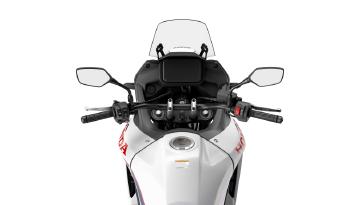
A full-color TFT screen uses optical bonding to improve visibility in bright sunlight. Glare is reduced by using resin to seal the gap between the cover glass and the TFT screen, and backlight transmittance is improved. Riders can customize the readout to their preferences, with three styles (bar, circle, and simple) plus black or white background options. In addition to selected ride mode, fuel level and gear selected, the rider can also view favorited information, such as total miles, A and B trip mileage, and average fuel consumption. Management is via the screen and switch cluster on the left side of the handlebar.
Connectivity with iOS/Android smartphones is available via Honda RoadSync, through a simplified, easy-to-use, backlit, four-way toggle-switch on the left side of the handlebar. The technology allows straightforward, on-screen, turn-by-turn navigation, as well as the option (via a Bluetooth helmet headset) for the rider to make calls or listen to music. All an owner has to do is download the Honda RoadSync app from either the App Store or the Play Store, connect to the Transalp and go.
This model is built to go the distance, so genuine comfort matters—also for riding two-up. Seat height is low for the class at 33.7 inches (a .4-inch-lower seat is also available as an accessory), and the riding position is upright for natural control and leverage. The riding geometry also works well when standing up. A rear carrier is standard, and there's a USB-C socket under the seat.
ENGINE / DRIVETRAIN
The 755cc, parallel-twin, eight-valve Unicam engine has bore and stroke figures of 87.0 x 63.5mm, with a compression ratio of 11.0:1. It produces mountains of torque in the low to mid rpm range, which is accompanied by a hard hit of top-end power. The result is an engine that provides usable, enjoyable performance across a wide range of riding scenarios and distances, and for riders of varying experience levels.
The engine is extremely compact and lightweight, due in part to the Unicam head (as used by the CRF450R motocrosser), which operates the 35.5mm diameter inlet valves (with 9.3mm lift) via cam, and 29mm diameter exhaust valves (with 8.2mm lift) by rocker arm.
The compact dimensions are also due to clever packaging: there's no balancer drive gear, since the primary drive gear doubles its duties by also spinning the balance shaft; the water pump is tucked away inside the left engine cover.
For razor-sharp pick-up and throttle response, patented vortex flow ducts create a uniform distribution from the side scoops into the airbox, which then feeds downdraft intakes and 46mm throttle bodies. To increase the engine's efficiency, the cylinders have a Nickel-Silicon Carbide coating (Ni-SiC), as used on the CRF450R and CBR1000RR-R Fireblade SP.
The crank has a 270° firing order for characterful, twin-cylinder pulse feeling. The exhaust note is tuned for a pleasing low-end beat and raucous top-end howl.
An assist/slipper clutch—with FCC leaning segment discs—reduces clutch-drag torque by 30%, for a lighter lever load and easier upshifts. It also manages rear-wheel hop under hard braking and rapid downshifts.
ELECTRONIC CONTROLS
To simplify and miniaturize the entire electrical system, the Transalp E-Clutch uses a Controller Area Network (CAN) alongside a Body Control Unit (BCU). The BCU is situated on the left frame rail, under the fuel tank, and it collectively processes control signals from the ABS modulator, TFT screen and switch cluster. All lighting is LED.
Riding Modes
Throttle-by-wire engine control offers four default riding modes—SPORT, STANDARD, RAIN and GRAVEL—adjusting the engine's performance delivery and feel to suit conditions and the rider's intent; they're easily switched and managed between the TFT screen and the Mode button on the left switch cluster. There are also two customizable USER modes that allow the rider to fine-tune his or her own personal settings.
Available are four levels of engine power (P), three levels of engine brake (EB), two ABS settings, and five levels of Honda Selectable Torque Control (HSTC); The riding modes offer different combinations of each parameter. Wheelie control is also standard and integrated with HSTC, which can be turned off in User modes.
The modes are:
- SPORT: A preset mode that offers maximum performance and uses level 4 P, level 2 ABS and level 1 EB and HSTC, to deliver strong acceleration with minimal intervention.
- STANDARD: This preset mode is a midway setting for urban riding that uses level 3 setting for P and HSTC, with level 2 EB and ABS.
- RAIN: Designed for challenging on-road conditions, this mode employs the lowest P setting (level 1), for the least-aggressive power delivery, with level 2 EB and ABS and level 5 HSTC.
- GRAVEL: Featuring level 2 P, level 3 EB and level 4 HSTC, with level 1 ABS setting, this mode enables confident travel on rougher off-road terrain.
- USER 1/USER 2: These modes allow the rider to choose between settings 1-4 P, 1-5 or off HSTC and 1-3 EB, as well on-road or off-road ABS.
Honda E-Clutch
Introduced on the 2024 CB650R and CBR650R, then extended to the 2025 Rebel 300 and CB750 Hornet, Honda E-Clutch brings next-level riding enjoyment and performance to the Transalp, allowing riders to start, stop and change gears without operating the clutch lever. The clutch and transmission hardware remain identical to those of a conventional motorcycle, yet the system allows consistent gear changes that are faster and smoother than a quick shifter, prevents stalling, and manages transitions smoothly—boosting convenience and rider confidence in stop-and-go urban traffic and on challenging inclines.
To smooth gear changes, the system uses precise clutch control while also adjusting ignition timing and fuel injection based on parameters such as vehicle speed, throttle-opening angle, engine rpm, pressure on the shift pedal, clutch-motor reduction-gear angle, engine-countershaft speed and gear position. The clutch operation itself is performed through an actuator unit, with two compact motors housed in a dedicated assembly on the right side of the engine.
In addition to these core clutch-control functions, Honda E-Clutch works in conjunction with the Transalp's throttle-by-wire system for even greater refinement. For instance, during downshifts, throttle blipping matches engine rpm to rear-wheel speed for smoother transitions. The system also adjusts the throttle-butterfly opening range depending on riding-mode selection. For example, RAIN mode supports confident control in wet conditions, while SPORT sharpens response for more spirited riding. Rear-wheel hop during aggressive downshifting and braking is mitigated through partial clutch engagement, improving stability. In off-road conditions, the system monitors both front and rear wheel speeds even when rear-wheel slip occurs, and achieves reliable upshifts by selecting an appropriate clutch-based shifting method.
Riders can tailor shift feel by selecting the force required at the shift pedal. Three settings are available—HARD, MEDIUM, and SOFT—each of which can be chosen independently for upshifting and downshifting.
In addition to enjoyment and convenience, Honda E-Clutch brings ultimate flexibility, allowing riders to use the clutch lever manually at any time if they choose. When the clutch lever is used, Honda E-Clutch temporarily pauses, then automatically reactivates—after less than a second at higher engine speeds or after five seconds at lower engine speeds. When E-Clutch is paused, manual operation is indicated by a letter "M" on the instrument panel. The technology also advises the rider to shift down (via a symbol on the instrument panel) if it detects that the motorcycle is in a high gear at a certain speed.
For extra legroom on the Transalp, the mounting structure of the E-Clutch system has been adjusted by dividing the clutch-lifter shaft in two and adding a gear train, offsetting it 1.6 inches away from the rider's foot. Also, the anti-vibration rubber and stays of the standard clutch-cover design were found to be unnecessary in testing, following optimization of the engine-cover design, ultimately saving .7 pounds
CHASSIS / SUSPENSION
The Transalp is designed to provide exceptional handling and ride comfort across a wide range of terrains, thanks to its meticulously engineered chassis and suspension system. With a focus on balance, durability and agility, the frame and suspension work in harmony to deliver stability on highways and confidence off-road.
Frame
The steel-diamond mainframe is lightweight at just 40.3 pounds—10% lighter than the frame of the NX500, for example. The integrated subframe is constructed of high-tension steel tubing for strength and toughness. A major R&D process of reducing the number of reinforcing parts, thinning of the main and down tubes, and optimizing the upper shock mount and swingarm pivot shape produced a very strong platform, with rigidity balanced to deliver comfort and positive feel to the rider across all conditions. The geometry is matched to inspire and deliver confident handling agility.
Rake and trail are set at 27.0° and 4.4 inches, respectively, with a wheelbase of 61.5 inches and curb weight of 468 pounds. Slow-speed U-turns are simplified thanks to a 42° steering angle and 8.6-foot minimum turning circle. Ground clearance is 7.7 inches.
Suspension
The Transalp E-Clutch's suspension specifications were selected with the "all-around" concept in mind, with long travel and superb bump absorption to deliver smooth performance and comfort on-road, while still providing good holdup off-road. For 2026, the fork and shock absorber feature new compression/rebound damping adjusters, allowing riders to better tailor suspension performance to their preferences and varying terrain conditions.
The 43mm Showa Separate Function Fork-Cartridge inverted fork has 7.9 inches of wheel travel. A forged-aluminum bottom triple clamp and cast-aluminum top triple clamp are used, for an ideal balance of strength and rigidity in wide-ranging riding situations.
The Showa shock absorber features adjustable preload and operates through a Pro-Link system, delivering 7.5 inches of rear-wheel travel. The swingarm employs the same castings from the Africa Twin, but uses aluminum material exclusive to the Transalp.
Brakes
Compact, two-piston calipers work the dual front 310mm "wave" rotors. The single rear 256mm "wave" disc is operated by a single-piston caliper. The stainless-steel, spoked 21-inch front and 18-inch rear wheels are fitted with tube-style 90/90-21 and 150/70R-18 tires, respectively.
Honda ACCESSORIES
The Transalp's accessory lineup includes 34 Honda Accessories, including a Comfort Seat, cargo options and much more.